
Night Driving Tips for Rideshare Drivers: What Changes When Daylight Saving Time Ends Nov. 1
Daylight saving time ends Nov. 1, 2026, and evening shifts move into the dark. Practical night driving tips for drivers in Atlanta, Houston and Dallas.
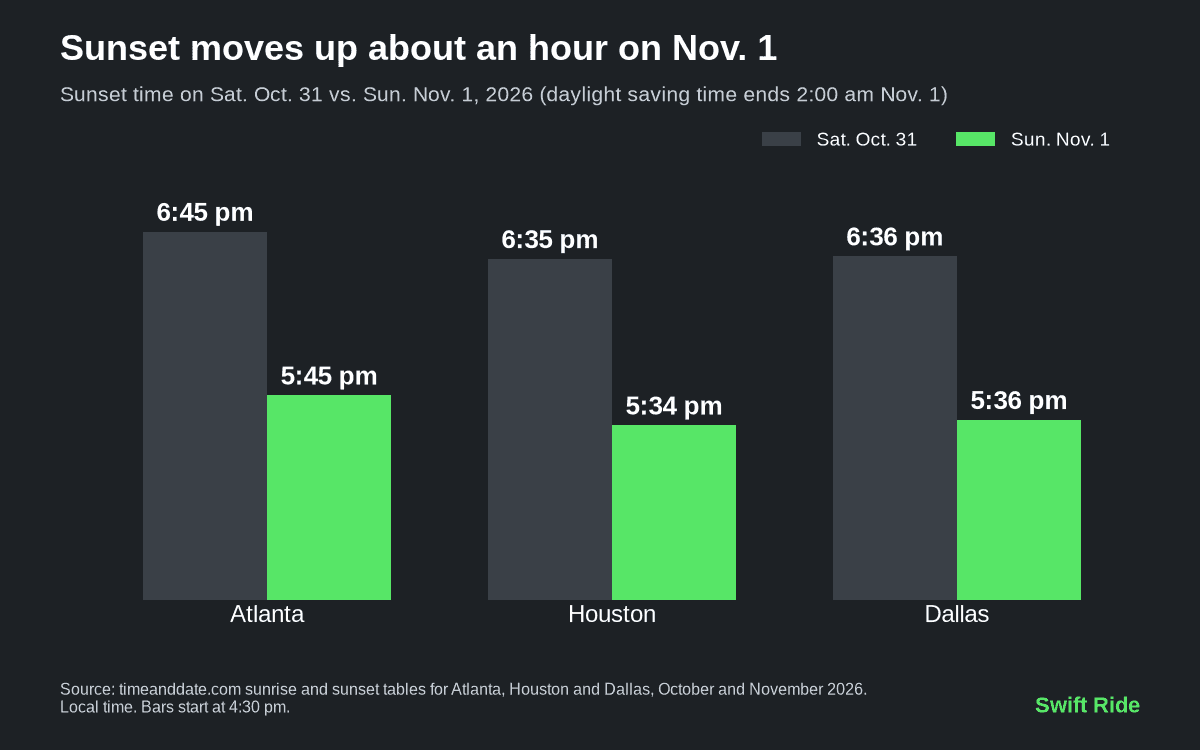
Your evening shift gets darker starting Sunday, November 1, 2026. Daylight saving time ends at 2:00 am that day, and clocks go back one hour. In Atlanta, sunset moves from about 6:45 pm on Saturday, Oct. 31, to 5:45 pm on Sunday, Nov. 1.
That means the busy after-work hours, dinner deliveries and the drive home from the airport all move into the dark. For Uber, DoorDash and Instacart drivers, that is more than an inconvenience. Night driving is harder on your eyes, harder on your focus and riskier for everyone on the road. Here are practical night driving tips for rideshare drivers in Atlanta, Houston and Dallas, what you can handle yourself, and an easier option if you would rather not deal with the car side of it.
Quick answer: how can rideshare drivers stay safe driving at night?
Make sure you can see and be seen, slow down, watch hard for people on foot, and do not drive tired. Most of it comes down to five habits:
- Lights and glass: clean your headlights, windshield (inside and out) and mirrors. Replace cloudy headlights.
- Speed and space: slow down and leave more following distance, because you see less at night.
- People on foot: expect pedestrians between 6 and 9 pm, especially away from intersections.
- Rest: do not start a night shift tired, and take a break at least every two hours.
- App safety tools: know where the safety button is in your Uber or delivery driver app before you need it.
When does daylight saving time end in 2026?
Daylight saving time ends at 2:00 am on Sunday, November 1, 2026, when clocks fall back one hour. In all three Swift Ride cities, sunset moves about an hour earlier overnight, according to timeanddate.com.
- Atlanta: sunset 6:45 pm on Oct. 31, then 5:45 pm on Nov. 1, and 5:28 pm by Nov. 30.
- Houston: sunset 6:35 pm on Oct. 31, then 5:34 pm on Nov. 1, and 5:21 pm by Nov. 30.
- Dallas: sunset 6:36 pm on Oct. 31, then 5:36 pm on Nov. 1, and 5:20 pm by Nov. 30.
The National Safety Council (NSC) points out that evening rush hour, about 4 to 7 pm on weekdays, is already a dangerous time to drive, and in winter it happens in the dark. For a lot of drivers, that is prime earning time.
Why is driving at night more dangerous?
Because you see less and have less time to react. NSC says that even with high beams, visibility is limited to about 500 feet, and about 250 feet with normal headlights. Depth perception, color recognition and side vision also get worse in the dark.
The numbers back it up. NSC says we do only about one quarter of our driving at night, but about half of traffic deaths happen at night. NSC also says the risk of a fatal crash is three times greater at night. In 2023, NHTSA counted 40,901 traffic deaths, and half of them (50%) happened in the dark.
Why should drivers watch for pedestrians after dark?
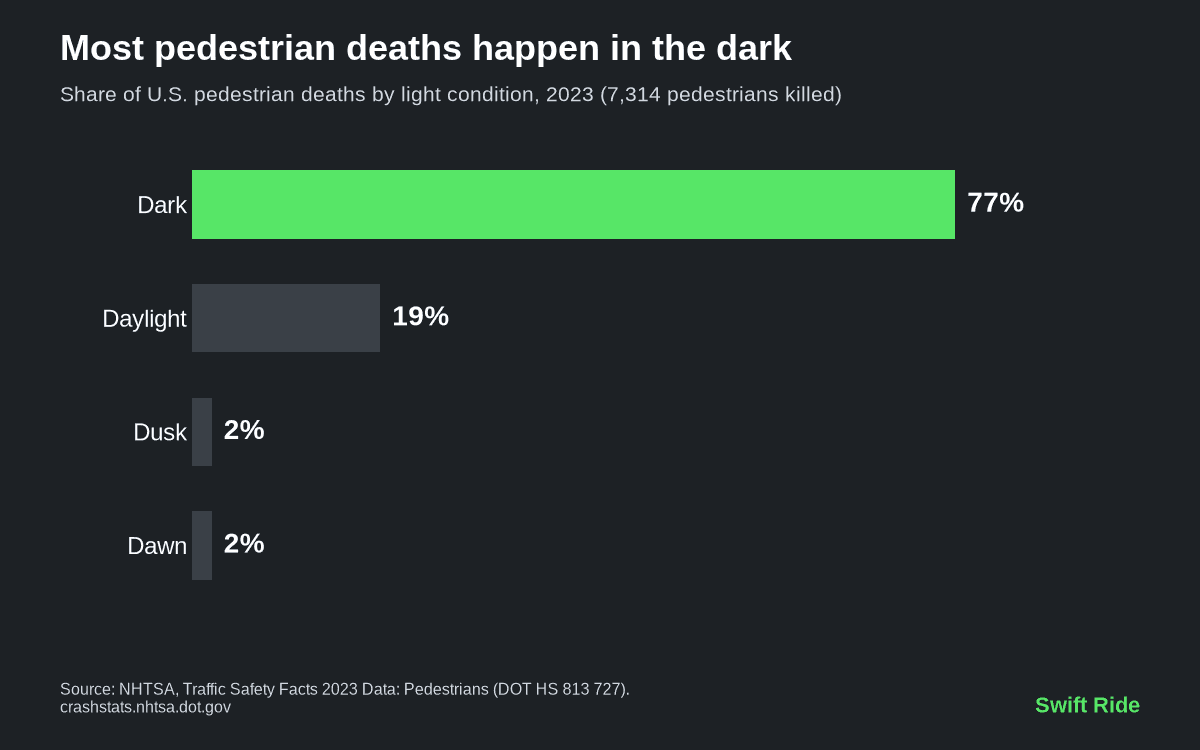
Because most pedestrian deaths happen at night. NHTSA says 77% of the 7,314 pedestrians killed in 2023 died in the dark, and 84% died in urban areas. In fall months (September to November), 32% of pedestrian deaths happened between 6 and 8:59 pm, the most of any time block.
NHTSA also found that 74% of pedestrian deaths happened away from intersections. That matters for gig drivers: riders walk to your car in the middle of the block, delivery customers step out to meet you, and people cross outside crosswalks near bars, stadiums and apartment complexes.
- Slow down on busy streets near restaurants, nightlife and apartment complexes.
- When you pull over for a pickup, scan for people walking toward or behind the car.
- Use your hazard lights when stopped for a pickup or drop-off where it is legal to stop.
How do I make sure my headlights are good enough?
Check that they are clean, clear and aimed right. Cloudy, yellowed headlights are a bigger problem than most drivers think. In a 2018 lab study, AAA found that deteriorated headlights on low beam produced only 22% of the light of new ones. Restoring them (DIY or professional) brought light output back to about 70%, and replacing them with original equipment parts brought it back to 100%.
What can I do myself?
- Wipe down headlights and taillights when you get gas. Dirt and road film cut light.
- Look at your headlight lenses in daylight. If they are yellow or hazy, consider a restoration kit or a replacement.
- Clean the inside of your windshield. Haze on the glass causes glare from oncoming lights.
- Dim your dashboard and your phone mount screen. NSC recommends dimming the dashboard.
- If oncoming lights blind you, look toward the right edge line of the road (an NSC tip) until they pass.
- Replace wipers that streak. Streaks scatter headlight glare at night.
How do I avoid drowsy driving on night shifts?
Do not start a shift tired, and stop when you feel it. NSC cites a National Sleep Foundation poll that found 60% of adults have driven while tired and 37% have fallen asleep at the wheel. NSC also cites an NHTSA report that 100,000 police-reported crashes are a result of driver fatigue.
The National Sleep Foundation's advice, via NSC:
- Get seven or more hours of sleep.
- Do not drive if you have been awake for 16 hours or more.
- Stop every two hours to rest.
- Pull over and nap if you are drowsy.
For gig drivers, that might mean ending a long day shift before the late rush instead of pushing through both. A missed hour is cheaper than a crash.
Are there more deer on the road in November?
Yes, fall is peak season for animal hits, which matters if you take airport runs or suburban trips at dusk. State Farm says October, November and December are the most dangerous months for animal collisions. Those three months made up 41% of animal collision claims from July 2024 to June 2025, and deer were again the top animal struck. In State Farm's prior year of data, November ranked No. 1.
State Farm's tips: slow down, scan the road edges, do not swerve if a hit can't be avoided, and if you see one deer, expect more nearby.
How can I stay safe with riders and deliveries at night?
Use the tools in your app, and trust your gut. Uber's driver app has a Safety Toolkit (the blue shield) with an Emergency Button and Follow My Ride, which shares your live location with people you trust.
- Confirm the rider's name before they get in, ideally before you unlock the car.
- For deliveries, park in well-lit spots and keep your car locked when you walk away.
- If a pickup spot feels wrong, move to a better-lit spot nearby and message the rider.
- If you ever feel unsafe, you can end the trip, and call 911 in an emergency.
To get the rest of your car ready for the season, see our winter car prep checklist for rideshare drivers.
What are your options for getting your car ready for night driving?
You have a few honest options, depending on your time, budget and how much you drive.
Option 1: Do the quick fixes yourself
Clean your lights and glass, swap streaky wipers, dim your screens and check that every bulb works by walking around the car with the lights on. It is cheap and takes about 20 minutes. A headlight restoration kit is a low-cost fix for cloudy lenses, but AAA's testing found restoration gets you back to about 70% of new light output, not 100%.
Option 2: Have a shop handle lights and aim
A shop can replace headlight assemblies, check headlight aim and fix a burned-out bulb you can't reach. This gives you the best light, but it costs money and time off the road. Estimate: add the repair bill to the earnings you miss while the car is in the shop to see the real cost.
Option 3: Shift when you drive
If your eyes or your car are not up for night driving, you can move more of your hours earlier in the day. That is a real option, but with sunset about an hour earlier from Nov. 1, it can mean giving up part of the after-work rush. (If you track car costs for taxes, our rideshare driver taxes guide explains what to keep.)
Or go with Swift Ride and let us handle the car
If you would rather spend your evenings earning instead of fixing headlights and wipers, Swift Ride is the easier path. Swift Ride rents cars to rideshare and delivery drivers, and our cars qualify for UberX and delivery platforms in all of our cities, including Atlanta, Houston and Dallas.
Per our Services page, Swift Ride rentals are fully managed:
- Full maintenance included, with no out-of-pocket repairs
- Every car is inspected and serviced regularly
- 24/7 roadside assistance, so you are not stuck alone on a dark roadside
- Commercial insurance coverage
- No long-term contracts
You still drive smart after dark. But the car side, the upkeep and the repair bills, is not on you. See how it works or browse our cars.
Ready for an easier winter of night shifts? Apply at swiftride.net in about 2 minutes.
Night driving checklist for rideshare drivers
| What to check | How to do it | When |
|---|---|---|
| Headlights and taillights | Clean lenses; walk around with lights on; restore or replace cloudy lenses | Weekly |
| Windshield and mirrors | Clean inside and out to cut glare | Weekly |
| Wipers | Replace if they streak | When they streak |
| Dashboard and phone screen | Dim them at night | Every night shift |
| Your rest | 7+ hours of sleep; break every 2 hours; stop if drowsy | Every shift |
| App safety tools | Find the shield, emergency button and location sharing | Before your next shift |
| Pickup spots | Choose well-lit spots; confirm rider name | Every trip |
FAQ
When does daylight saving time end in 2026?
At 2:00 am on Sunday, November 1, 2026. Clocks go back one hour, and sunset in Atlanta, Houston and Dallas moves to about 5:35 to 5:45 pm.
Is it more dangerous to drive Uber at night?
Yes. NSC says the risk of a fatal crash is three times greater at night, and about half of traffic deaths happen at night even though only about a quarter of driving does. Slow down, watch for pedestrians and do not drive tired.
How far can I see with headlights at night?
NSC says about 250 feet with normal headlights and about 500 feet with high beams. Drive at a speed that lets you stop within the distance you can see.
Do cloudy headlights really matter?
Yes. AAA's testing found deteriorated headlights on low beam gave only 22% of the light of new headlights. Restoration got them to about 70%, and replacement with original parts got them to 100%.
What safety features does Uber have for drivers at night?
Uber's driver app has a Safety Toolkit with an Emergency Button and Follow My Ride location sharing.
Does Swift Ride cover maintenance and roadside help?
Yes. Swift Ride's Services page lists full maintenance, 24/7 roadside assistance and commercial insurance coverage. You can apply at swiftride.net in about 2 minutes.
This article is general safety information, not legal or professional advice. Always follow your vehicle maker's manual, your platform's safety guidance and local laws.
Sources
- timeanddate.com, Atlanta sunrise and sunset, October and November 2026 (notes DST ends Nov. 1, 2026 at 2:00 am): https://www.timeanddate.com/sun/usa/atlanta?month=11&year=2026
- timeanddate.com, Houston sunrise and sunset, November 2026: https://www.timeanddate.com/sun/usa/houston?month=11&year=2026
- timeanddate.com, Dallas sunrise and sunset, November 2026: https://www.timeanddate.com/sun/usa/dallas?month=11&year=2026
- National Safety Council, "Driving at Night": https://www.nsc.org/road/safety-topics/driving-at-night
- National Safety Council, "Safety Tips for Fall Driving" (fatal crash risk three times greater at night): https://www.nsc.org/getmedia/12d75a9a-352c-4be7-845e-37616bcf1884/fall-driving-eng.pdf.aspx
- NHTSA, Traffic Safety Facts 2023 Data: Pedestrians (DOT HS 813 727): https://crashstats.nhtsa.dot.gov/Api/Public/ViewPublication/813727.pdf
- NHTSA, Traffic Safety Facts 2023 Data: Rural/Urban Traffic Fatalities (light condition table): https://crashstats.nhtsa.dot.gov/Api/Public/ViewPublication/813728
- AAA Newsroom, "AAA Illuminates the Dangers of Driving with Cloudy Headlights" (Dec. 11, 2018): https://newsroom.aaa.com/2018/12/dangers-driving-cloudy-headlights/
- AAA, Headlamp Lens Deterioration research report (2018): https://www.aaa.com/AAA/common/AAR/files/Headlamp-Lens-Deterioration.pdf
- State Farm Newsroom, animal collision data, July 2024 to June 2025 (Sept. 2025): https://newsroom.statefarm.com/new-state-farm-data-reveals-fewer-animal-collisions-but-autumn-months-remain-most-dangerous/
- State Farm Newsroom, animal collision data and tips, July 2023 to June 2024: https://newsroom.statefarm.com/animal-collisions-24/
- Uber, "Is Uber Safe for Drivers?": https://www.uber.com/us/en/drive/safety/
- Swift Ride Services page: https://swiftride.net/services
- #night driving
- #daylight saving time
- #rideshare tips
- #gig drivers
- #atlanta
- #houston
- #dallas