
Rideshare Driver Taxes 2026: Your Year-End Checklist for Mileage, Tips and the January 15 Deadline
Two IRS mileage rates, a new tips deduction and a January 15, 2027 estimated tax deadline. Here is a plain year-end tax checklist for Uber, Lyft and delivery drivers.

If you drive for Uber, Lyft, DoorDash, Instacart or a similar app, 2026 has a few tax changes that matter to you. The IRS raised the mileage rate halfway through the year, a new deduction for tips is in effect, and your last estimated tax payment for 2026 is due January 15, 2027. Here is a plain checklist you can work through before the holiday rush.
Quick note: this post is general education, not tax advice. Every driver's situation is different, so talk to a tax professional before you file or make payments.
What is the 2026 IRS mileage rate for rideshare drivers?
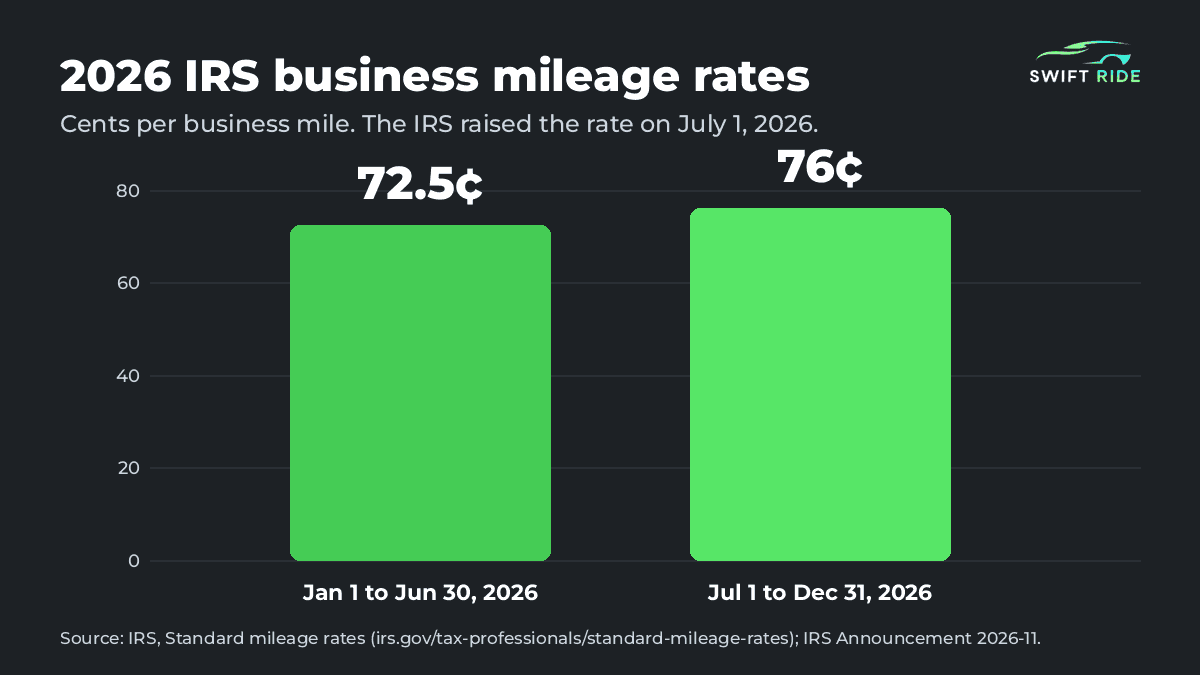
For 2026 the IRS set two business rates. Miles driven from January 1 through June 30 use 72.5 cents per mile. Miles driven from July 1 through December 31 use 76 cents per mile. The IRS raised the rate mid-year because of higher fuel prices, so you need to split your 2026 miles by date.
The second-half increase came from IRS Announcement 2026-11, which says the change "results from recent increases in the price of fuel." (IRS Standard mileage rates; Internal Revenue Bulletin 2026-29)
How to split your miles
- Pull your mileage reports for January through June and for July through December separately.
- Multiply each half by its own rate.
- Add parking fees and tolls for business trips on top. The IRS says those are separately deductible whether you use the standard mileage rate or actual expenses. (IRS Topic 510)
Simple math example (illustration only, not an estimate of your deduction): 1,000 business miles in the first half at 72.5 cents is $725. 1,000 business miles in the second half at 76 cents is $760.
What mileage records do I need to keep?
The IRS asks you to record the mileage for each business use and the total miles you drove for the year. Keep those records, and receipts that support your deductions, generally for 3 years from the date you file. An app-based mileage log or a written log both work if they are complete.
That guidance comes from IRS Publication 463, chapter 5. A few habits that help:
- Start your mileage tracker before you go online, not after your first ping.
- Write down your odometer reading on January 1 (or the day you start using a car for gig work) and on December 31.
- Save platform summaries and weekly statements in one folder each month.
- Keep receipts for tolls, parking, phone mounts, chargers and car washes used for work.
Standard mileage or actual expenses: which method should I use?
The IRS allows two methods. The standard mileage rate multiplies business miles by the IRS rate. The actual expense method adds up real costs (gas, repairs, tires, insurance, registration, and depreciation or lease payments) for the business-use share. The IRS suggests figuring it both ways when you qualify for both.
Some rules from IRS Topic 510 to know:
- To use the standard mileage rate, you must own or lease the car.
- For a car you own, you must choose the standard mileage rate in the first year the car is used for business if you want the option to use it later.
- For a leased car, if you choose the standard mileage rate, you must keep using it for the entire lease period, including renewals.
If you rent your car
If you drive a rental, ask your tax pro how your rental agreement is treated and which method fits. Under the actual expense method, the IRS lists lease payments among the costs you can count for the business-use portion. (IRS Topic 510) Keep every rental receipt and statement, along with your mileage log, so your tax pro has what they need.
Do rideshare and delivery drivers qualify for "no tax on tips"?
Many do. The IRS list of qualifying tipped occupations includes taxi and rideshare drivers (code 802) and goods delivery people, including app or platform-based delivery workers (code 804). The deduction runs for tax years 2025 through 2028 and is capped at $25,000 per return.
Key details from the IRS (What the No Tax on Tips deduction means for you; Filing tips and updates for gig economy workers; List of occupations that received tips):
- Qualified tips are voluntary cash or charged tips from customers.
- If you are self-employed, the deduction cannot be more than your net income from the work where you earned the tips.
- It phases out when modified adjusted gross income is over $150,000 ($300,000 for joint filers).
- Married couples must file jointly, and you need a valid Social Security number.
- You can claim it whether you itemize or take the standard deduction.
Tip: your app may lump tips into your total pay. Download your yearly earnings summary from each platform and keep it with your tax records so you can show how much came from tips.
When is the next estimated tax payment due?
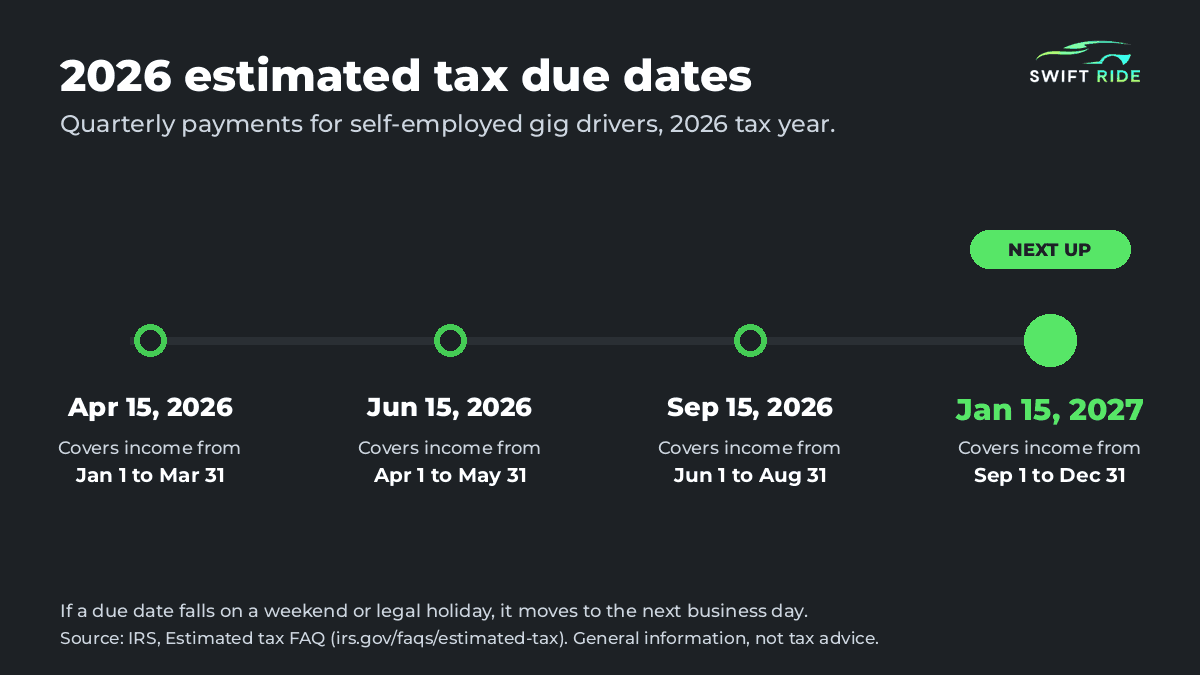
Your fourth estimated tax payment for 2026 covers income earned September 1 through December 31, 2026, and is due January 15, 2027. The IRS says you generally need to make estimated payments if you expect to owe at least $1,000 for the year after withholding and credits.
Source: IRS Estimated tax FAQ. The IRS also lists these 2026 periods (Manage taxes for your gig work):
- April 15 for January 1 through March 31
- June 15 for April 1 through May 31
- September 15 for June 1 through August 31
- January 15 of the next year for September 1 through December 31
If you missed an earlier payment, paying what you can now may still help. The IRS notes you can be charged a penalty for underpaying even if you end up due a refund. You can pay through your IRS online account, Direct Pay, by phone, or in the IRS app.
How the IRS "safe harbor" works
According to the IRS Estimated tax FAQ, you generally must pay estimated tax if your withholding and credits will be less than the smaller of:
- 90% of the tax on your 2026 return, or
- 100% of the tax on your 2025 return (110% if your 2025 adjusted gross income was over $150,000, or $75,000 if married filing separately).
Ask your tax pro which target makes sense for you.
How much is self-employment tax?
Self-employment tax is 15.3% (12.4% for Social Security and 2.9% for Medicare). It generally applies to 92.35% of your net earnings once those reach $400 or more. You can deduct half of it when figuring the adjusted gross income on your Form 1040.
Source: IRS Topic 554. This is why tracking expenses matters: self-employment tax is figured on your net earnings, after business expenses, not your gross app payouts.
What tax forms will I get from the apps?
You may receive Form 1099-K, 1099-NEC or 1099-MISC from the platforms you work with, usually by January 31. Under current law, payment apps and marketplaces send a 1099-K when you receive more than $20,000 and have over 200 transactions in a year. You must report all your income either way.
Sources: Manage taxes for your gig work and Filing tips and updates for gig economy workers. Self-employed drivers generally report on Form 1040 with Schedule C (profit or loss) and Schedule SE (self-employment tax).
Your year-end tax checklist for gig drivers
Work through this list before the holiday season gets busy:
- Split your 2026 miles into January to June and July to December.
- Fill gaps in your mileage log now, while your memory and app history are fresh.
- Gather receipts for tolls, parking, phone and car-related costs in one folder.
- Download earnings summaries from every app you drove for, including tips.
- Check your estimated payments made so far this year and plan for January 15, 2027.
- Set money aside weekly from your payouts so January is not a surprise. Your tax pro can help you pick an amount.
- Book time with a tax professional before February, when calendars fill up. The IRS also offers Free File and Volunteer Income Tax Assistance options for eligible filers.
Keep your car working as hard as you do
The holiday season is a busy time to be on the road, and a reliable car keeps your hours (and your mileage log) on track. If you want a car that is ready for rideshare and delivery work, see how Swift Ride works or browse available cars. We are here to help you keep driving, and keeping your rental statements organized makes tax time simpler too.
Frequently asked questions
What is the IRS business mileage rate for 2026?
The IRS business rate is 72.5 cents per mile for January 1 through June 30, 2026, and 76 cents per mile for July 1 through December 31, 2026. (IRS)
When is the last 2026 estimated tax payment due?
January 15, 2027, for income earned from September 1 through December 31, 2026. (IRS)
Do I have to report gig income if I don't get a 1099?
Yes. The IRS says you must report all income from gig work, even if you do not receive a Form 1099 or other information return. (IRS)
Can delivery drivers use the no tax on tips deduction?
The IRS list of qualifying occupations includes app or platform-based delivery workers and rideshare drivers. The deduction is up to $25,000 per return for 2025 through 2028, with income limits. Check your details with a tax pro. (IRS)
When do I have to pay self-employment tax?
Generally when your net earnings from self-employment are $400 or more. The rate is 15.3% on 92.35% of net earnings. (IRS)
Can I deduct tolls and parking on top of the mileage rate?
Yes. The IRS says parking fees and tolls for business use are separately deductible whether you use the standard mileage rate or actual expenses. (IRS)
How long should I keep my mileage log and receipts?
Generally 3 years from the date you file the return that claims the deduction, per IRS Publication 463. (IRS)
This article is general information, not tax, legal or financial advice. Tax rules change and your situation is unique. Please talk to a qualified tax professional before making decisions.
Sources
- IRS, Standard mileage rates
- IRS, Internal Revenue Bulletin 2026-29 (Announcement 2026-11)
- IRS, Topic no. 510, Business use of car
- IRS, Publication 463, Travel, Gift, and Car Expenses
- IRS, Estimated tax FAQ
- IRS, Manage taxes for your gig work
- IRS, Topic no. 554, Self-employment tax
- IRS Tax Tip 2026-26, Filing tips and updates for gig economy workers
- IRS, What the "No Tax on Tips" deduction means for you
- IRS, Occupations that customarily and regularly received tips on or before Dec. 31, 2024
- #rideshare taxes
- #gig drivers
- #irs mileage rate
- #estimated taxes
- #no tax on tips